
Virtual Sheet Music, Inc. Review: Is It Worth Exploring for Music Enthusiasts?

Finding the right sheet music can make a significant difference in your musical journey. Whether you are learning piano, practicing violin, preparing for a concert, teaching students, or simply enjoying music as a hobby, having access to clear and reliable musical scores makes practice much easier. However, traditional sheet music can be expensive, difficult to find in local stores, and inconvenient to carry around. Digital platforms offer another option by allowing musicians to discover, download, print, and practice music from their computers, tablets, and other devices.
One platform worth considering is Virtual Sheet Music, Inc., a digital sheet music service that has operated since 1999. It offers musical scores, exclusive arrangements, downloadable files, audio resources, and interactive tools designed to support different kinds of musicians. Its catalog focuses strongly on classical and traditional music while also providing works from other publishers. The platform has expanded beyond basic downloads by introducing tools such as its online Playground editor and AI Music Assistant.
But does it offer enough value to justify exploring its catalog or paying for a membership? Is it useful for beginners, or is it better suited to experienced performers and music teachers? And how does its subscription model compare with simply purchasing individual scores?
This Virtual Sheet Music, Inc. review explores the platform’s catalog, features, pricing, advantages, limitations, and potential uses. By the end, you should have a clearer idea of whether it fits your musical goals and budget.
Table of Contents
What Is Virtual Sheet Music, Inc.?
Virtual Sheet Music, Inc. Music is an online destination for people who want to access musical scores digitally. Instead of visiting a physical music shop or waiting for printed books to arrive, users can browse available titles online and obtain supported digital editions. The company says it was founded in 1999 by Maestro Fabrizio Ferrari and Professor Laura Caldera, with a mission to make quality sheet music easier for musicians and music enthusiasts to access. Its catalog and related services have developed around digital delivery, downloadable scores, and supplementary music resources.
The basic idea is straightforward: make sheet music easier to discover, access, and use. Imagine preparing for a piano recital and needing a particular classical composition. Rather than searching through several physical stores, you can look for the piece online, review the available edition, and determine whether it suits your instrument and skill level. When a suitable digital version is available, you can download it, print it, or use it with a compatible device or music-reading application.
The platform is not simply a collection of generic music files. It offers its own editions and arrangements alongside works from other publishers. Depending on the title, users may also find supporting media such as MIDI files, MP3 recordings, accompaniment tracks, or interactive resources. These additions can help musicians understand how a piece sounds before attempting to perform it themselves.
Understanding Its Digital Sheet Music Library
The library is one of the main reasons musicians may want to explore the service. Virtual Sheet Music, Inc. Music provides scores for different instruments and musical abilities, with a particular emphasis on classical repertoire. Its offerings include original compositions, traditional music, and arrangements intended for particular instruments or ensembles.
For example, a pianist might look for a solo arrangement, while a violinist could search for a melody with piano accompaniment. A teacher may want several pieces at different difficulty levels to help students develop technique gradually. The ability to search for music online makes it easier to compare options before selecting a piece.
However, not every title necessarily includes the same files or benefits. One score might come with audio resources, while another may offer a different set of downloadable materials. Some titles may be accessible through a membership, whereas other copyrighted works are offered at individual prices or discounted rates. Checking the details on the specific product page is therefore more useful than assuming every item includes every feature.
What Types of Sheet Music Can You Find?
The usefulness of any sheet music platform depends largely on whether it carries music you actually want to play. Virtual Sheet Music, Inc. Music has a substantial focus on classical and traditional repertoire, but its catalog also includes works from third-party publishers. Its official website highlights music for multiple instruments, exclusive arrangements, and digital resources for musicians at different skill levels.
This makes it worth investigating for learners who are developing foundational skills as well as experienced performers searching for repertoire. Nevertheless, musicians interested mainly in the latest commercial pop releases, specialist contemporary genres, or a particular niche should search for their preferred titles before deciding that the platform is suitable.
Classical Music, Contemporary Pieces, and More
Classical music is a central part of Virtual Sheet Music, Inc. Music’s identity. Musicians can explore compositions associated with the established classical repertoire and look for arrangements suited to their instruments. For someone studying piano, for instance, the catalog may provide opportunities to discover pieces that develop finger independence, phrasing, rhythm, and musical expression.
Traditional music is another area worth exploring. Traditional melodies can be useful for beginners because familiar tunes often make practice more enjoyable, while more elaborate arrangements can challenge experienced players. A teacher might use a simple melody to introduce rhythm or articulation, then move to a more demanding version as the student progresses.
The platform also distributes selected titles from outside publishers. This matters because musicians often need more than one type of music. A performer might practice a classical sonata during the week and prepare a different arrangement for a community performance over the weekend. Access to several categories within one service can simplify that process.
Still, variety does not guarantee that every requested song will be available. If your goal is to learn a particular modern hit or perform a specific copyrighted arrangement, search the exact title and verify the instrument, arrangement, and licensing details before purchasing. A broad catalog is valuable, but the right edition is more important than the number of titles advertised.
Key Features and Benefits
Virtual Sheet Music, Inc. Music combines digital scores with tools designed to make learning and practicing more convenient. Its official website promotes downloadable PDFs, supporting media, an interactive Playground editor, an AI Music Assistant, educational materials, and mobile applications. Availability can differ by title, plan, and device, so users should review the relevant feature descriptions before relying on a particular tool.
Downloadable PDF Sheet Music
One of the most practical benefits is the availability of digital sheet music in PDF format for supported titles. PDFs can be convenient because they are easy to store, print, and use with compatible devices. A musician who practices in different rooms or travels regularly may appreciate having scores available without carrying a collection of printed books.
Digital files can also help teachers organize their lesson materials. Rather than searching through piles of paper, they can keep relevant scores in clearly named folders on a computer or tablet. Musicians who prefer paper can print their files and annotate the pages using pencils or other suitable marking tools.
However, digital access should not be confused with unrestricted use. A purchased score may remain subject to copyright and the platform’s terms. Before copying, sharing, distributing, or using a score in a public or commercial setting, check the applicable permissions.
Audio and MIDI Resources
Some Virtual Sheet Music, Inc. Music editions include MP3 files, MIDI files, or accompaniment recordings. These resources can be helpful when a musician wants to hear a piece before attempting to play it. Listening provides an additional way to understand tempo, phrasing, rhythm, and the relationship between different musical parts.
Consider a violin student who is learning a piece with piano accompaniment. Reading the violin line alone may not reveal how the two parts fit together. An available accompaniment track can help the student become familiar with the musical structure and prepare for rehearsals.
MIDI playback can also provide a useful reference for pitches and timing. However, MIDI and synthesized audio may sound different from a live performance, particularly when the music depends on expressive phrasing, nuanced dynamics, or the unique tone of an acoustic instrument. Treat these resources as practice aids rather than perfect substitutes for listening to skilled musicians.
The Virtual Sheet Music Playground
The company’s Playground is an online music editor designed to let users interact with sheet music. Virtual Sheet Music, Inc. Music describes features such as playback, transposition, and instrument changes, and says the tool can also work with users’ own files.
Transposition can be especially helpful when a piece needs to be adapted to a different key or instrument. A musician may find an arrangement that is otherwise suitable but would prefer a different pitch range. A transposition tool can simplify experimentation, although users should always check the resulting notation carefully before performing it.
Playback provides another way to engage with a score. Instead of relying entirely on visual reading, musicians can listen while following the notes. This can support practice, especially when learning an unfamiliar passage.
The Playground may be useful for learners who want to explore how notation and sound connect. Experienced musicians may also appreciate the ability to experiment with arrangements. Still, the practical value depends on the user’s needs, familiarity with digital tools, and the specific file being edited.
AI Music Assistant and Learning Resources
Virtual Sheet Music, Inc. Music also promotes an AI Music Assistant intended to answer music-related questions. The service may be useful when users want help understanding musical concepts or exploring questions that arise during practice. The website also highlights educational materials, video lessons, music theory content, and practice resources.
For example, a beginner might want a simpler explanation of a musical term or need help understanding the role of a particular notation symbol. A teacher might use an assistant to generate ideas for explaining a concept in more accessible language. These tools can make the platform more than a place to obtain scores.
There is an important distinction, however, between general learning assistance and expert musical judgment. An AI tool may provide a useful starting point, but musicians should verify technical, theoretical, and performance-related answers when accuracy matters. It should support learning rather than replace an experienced teacher or a careful reading of authoritative musical materials.
Membership, Pricing, and Access
Pricing is an important part of any Virtual Sheet Music, Inc. Music review, because a useful library is not automatically a good purchase. The platform offers free access with limitations and a paid membership that adds benefits. According to the official membership page accessed for this review, the advertised price is $37.75 for the first year, with optional renewal at $25.99. The signup page also displays a $49.99 price alongside the first-year offer, so prospective members should verify the current amount and terms at checkout.
What Does the Free Option Include?
The free plan provides a way to create an account and explore some of the platform’s functionality without immediately paying for a membership. The current signup page lists features such as saving and retrieving orders, limited-time viewing of Virtual Sheet Music, Inc. Music editions, limited Playground and AI Music Assistant access, and a wish list
This option makes sense for people who are still deciding whether the service meets their needs. You can investigate the catalog, look at individual score pages, and understand how the platform works before committing money. It may also be enough for someone who only needs occasional access to the free material and does not require the full set of membership benefits.
The main limitation is that free access does not mean unrestricted access to the entire catalog. Some downloads, media files, tools, and copyrighted titles may require membership or an additional purchase. Read each item’s access details carefully to avoid confusing a preview with a downloadable score.
What Does a Paid Membership Offer?
The paid membership adds access to the archive of Virtual Sheet Music, Inc. Music editions and PDFs, media downloads for supported editions, discounts on other editions and products, unlimited Playground access, unlimited AI Music Assistant use, and premium musical support. The company also advertises a 30-day money-back guarantee.
For musicians who regularly learn new pieces, this combination may offer meaningful value. A piano student who downloads scores frequently, for instance, could benefit from access to the included repertoire and associated media. A music teacher who prepares lessons for several students may also find that a broader selection saves time.
However, a membership should not be assumed to make every item on the website free. The official offer distinguishes included Virtual Sheet Music editions from other editions and products available at discounted prices. If you mainly want a handful of specific songs, buying them individually may be more economical than paying for a membership you rarely use.
Before subscribing, consider how often you expect to use the service, which titles you need, and whether the membership includes those titles. Check renewal terms as well: the official page says renewal is optional rather than automatic, but you should always confirm the conditions presented when you sign up.
Membership Cost at a Glance
Feature | Free plan | Paid membership |
Account and order management | Included | Included |
Wish list | Included | Included |
Access to Virtual Sheet Music editions | Limited-time viewing | Broader access to editions and PDFs |
Media downloads | Limited by access and title | Included for supported VSM editions |
Playground | Limited access | Unlimited access |
AI Music Assistant | Limited access | Unlimited access |
Discounts on other editions and products | Not listed as a membership benefit | Advertised discounts |
Best suited to | Exploring the service | Frequent users who benefit from included editions and tools |
Plan features are based on the company’s published membership information. Check the official website for current terms and title-specific restrictions.
User Experience and Ease of Navigation
A sheet music website can offer thousands of compositions and still feel frustrating if users cannot find what they need. For that reason, navigation and search are important considerations when evaluating Virtual Sheet Music, Inc. Music. The platform provides an online catalog where visitors can explore musical titles, examine available editions, and identify resources suited to their instruments and interests. Its digital approach is particularly convenient for musicians who prefer researching music from home instead of visiting several physical stores.
Finding the Right Musical Score
When searching for sheet music, start with the composition’s title or composer’s name. If you already know the piece you want to perform, a direct search can help you determine whether the platform offers a suitable edition. If you are exploring new repertoire, consider searching by instrument, difficulty level, or musical category where those filters are available.
It is equally important to inspect the details of the score before making a decision. A composition may have several arrangements, each designed for a different instrument or level of experience. A beginner who accidentally selects an advanced arrangement could find the music discouraging, while an experienced performer might prefer a more demanding version.
Pay attention to the number of pages, instrumentation, accompaniment requirements, and included media. If you plan to use the music during a performance, check that the notation is readable at your intended display or print size. A few minutes spent examining the listing can prevent unnecessary purchases and help you choose music that supports your goals.
Using Sheet Music on Digital Devices
Digital sheet music works particularly well for musicians who already use a tablet or computer during practice. Rather than carrying a thick binder, they can store multiple scores on a single device. Virtual Sheet Music, Inc. Music also offers mobile applications, and its app listings describe downloadable music, offline playback of supported files, score organization, printing options, and page-turning features.
This can be useful for musicians who perform regularly. A pianist preparing for a recital might organize several pieces in advance, while an instrumentalist could keep practice material accessible during rehearsals. Offline access is also valuable when an internet connection is unreliable, provided the relevant files have been downloaded beforehand.
Still, the ideal setup depends on personal preference. Some musicians prefer printed pages because they can annotate them freely, while others appreciate the portability of a tablet. Before building your entire practice routine around an application, check its compatibility with your device and test its page display, navigation, and file-handling features.
Who Can Benefit From Virtual Sheet Music?
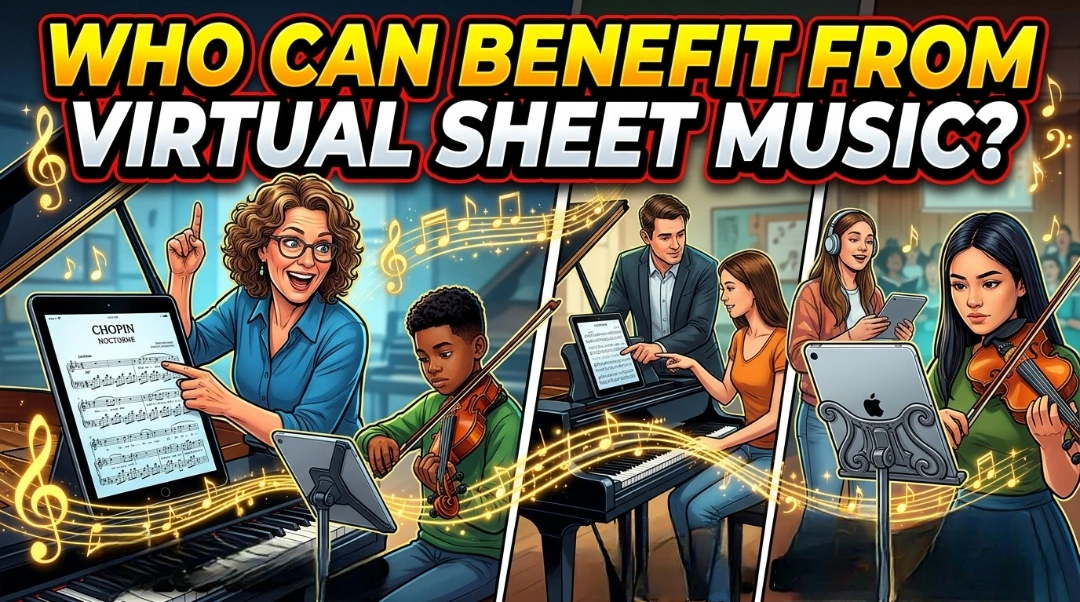
Virtual Sheet Music is not limited to one type of musician. Its combination of scores, digital files, audio resources, and interactive tools may appeal to beginners, experienced performers, teachers, and people who simply enjoy playing music at home. However, its value depends on the user’s repertoire, practice habits, and expectations.
Beginners Learning an Instrument
If you are learning piano, violin, flute, guitar, or another instrument, finding suitable music can make practice more enjoyable. Beginners often need pieces that reinforce basic skills without becoming so difficult that progress feels impossible. A digital catalog gives learners an opportunity to explore available repertoire and select music that matches their current abilities.
Audio resources can provide an additional reference when learning an unfamiliar composition. A student can listen to a supported recording, follow the notation, and then attempt the passage independently. Repeating this process can help connect the written notes with the sounds produced by the instrument.
Nevertheless, a sheet music platform cannot automatically make every piece beginner-friendly. A recognizable melody might still contain difficult rhythms, unfamiliar fingering patterns, or advanced techniques. Beginners should check the arrangement’s difficulty and seek guidance from a teacher when necessary.
Music Teachers and Private Instructors
Teachers frequently need a range of pieces for students with different abilities and interests. One learner may be ready for a more demanding classical composition, while another may need a simpler arrangement that reinforces rhythm and note reading. A digital music library can help instructors investigate suitable repertoire without relying exclusively on printed collections.
Virtual Sheet Music, Inc. Music’s additional resources may also support lesson preparation. Teachers can explore available audio files, use compatible interactive tools, and introduce students to music they might not encounter otherwise. These resources may be particularly useful when an instructor wants to demonstrate how a piece sounds before asking a student to practice it.
However, teachers should consider copyright and licensing before distributing material. A digital purchase does not necessarily grant permission to make unlimited copies for an entire class. Reviewing the terms for each score helps ensure that teaching materials are used appropriately.
Advanced Players and Professional Musicians
Experienced musicians often have more specific requirements than beginners. They may need a particular edition, accurate notation, a suitable arrangement, or scores that are easy to access during rehearsals. For these users, the quality and suitability of the individual edition matter more than a platform’s general appearance.
Virtual Sheet Music, Inc. Music emphasizes its own professionally prepared editions and offers PDF files designed for digital use. Its media resources and transposition features may also assist musicians who want to study a piece or explore alternative arrangements.
Professional performers should still examine each score carefully. If a recital or audition requires a specific edition, confirm that the available version meets the organizer’s requirements. A convenient digital file is valuable, but it cannot compensate for selecting the wrong arrangement or an unsuitable edition.
Hobbyists and Casual Music Lovers
You do not need to be a professional musician to benefit from digital sheet music. Many people play an instrument because they find it relaxing, enjoy revisiting familiar melodies, or want a creative activity outside their regular work. For these musicians, convenience and variety may be more important than advanced editing capabilities.
A hobbyist might use the platform to find a new piece for weekend practice or discover music from a composer they have never studied. The ability to browse from home makes it easier to explore without immediately committing to a printed collection.
The main consideration is frequency of use. If you regularly practice and enjoy learning new pieces, a membership could be worth evaluating. If you only play occasionally, free resources or individual purchases may provide better value.
Advantages and Potential Drawbacks
A balanced review should consider both what a platform does well and where it may not meet every user’s expectations. Virtual Sheet Music, Inc. Music combines digital delivery, a specialized catalog, supplementary media, and learning tools. These features can be attractive, but their practical value varies depending on what you want from the service.
Major Advantages
- Convenient digital access
The ability to obtain supported scores online can save time and reduce the need to store physical books. Musicians can access their files from compatible devices and print them when needed.
- A catalog focused on musical repertoire
The platform’s emphasis on classical and traditional music makes it worth exploring for musicians who regularly study these genres. Its inclusion of other publishers also gives users opportunities to investigate different editions and arrangements.
- Supplementary audio and interactive tools
Supported MP3 and MIDI files can help users understand how music sounds, while the Playground offers interactive features such as playback and transposition. These tools add practical value beyond simply downloading a PDF.
- Options for different budgets
The availability of a free account allows people to explore some features before deciding whether to pay. A paid membership provides additional benefits for users who regularly need included editions and associated tools.
- Potential value for frequent users
Musicians who download music regularly may benefit from the membership’s included repertoire and discounts. For these users, a subscription can be more practical than buying every eligible piece separately.
Potential Drawbacks to Consider
- Not everything is included in the membership
This is an important distinction. Some editions and products are available at discounted prices rather than included without additional charges. Users who assume that membership covers the entire catalog may be disappointed if they do not review the terms carefully.
- The catalog may not contain every requested title
A broad collection does not guarantee that a particular song or arrangement is available. Musicians focused on a niche genre or a specific contemporary release should search for their required titles before subscribing.
- The value depends on usage
A membership is easier to justify when you regularly access included scores or use the additional tools. Someone who downloads one or two pieces a year might spend less by purchasing individual scores or using legitimate free resources.
- Digital tools may require adjustment
Musicians who are accustomed to printed books may need time to become comfortable with tablet-based scores, online editors, and digital file organization. These tools are useful only when they fit the user’s workflow.
- Audio playback may not replace a real performance
Synthesized playback can help explain notes and timing, but it may not capture the expressive qualities of a skilled musician. Users who need interpretive guidance should also listen to live or professionally recorded performances when possible.
What Do Customer Reviews Suggest?
Independent customer feedback is another useful factor, although it should be interpreted carefully. The Trustpilot profile available during research showed a small number of reviews and a mixed-to-negative overall picture, including complaints from customers who felt that the membership did not provide as much free access as they expected. One reviewer questioned the value of paying an annual fee when the titles they needed were already available elsewhere, while another criticized the distinction between membership access and discounted purchases. The company responded to one complaint by stating that its membership terms explain which titles are included and which are discounted.
Because the number of reviews on that profile is small, it would be misleading to treat them as a definitive measure of the experience of all customers. However, the complaints highlight a practical lesson: understand exactly what the membership includes before paying. Check whether your preferred scores are included, whether you need to purchase other titles separately, and whether the available discounts are useful for your needs.
The most sensible approach is to combine customer feedback with your own inspection of the catalog, pricing information, and membership conditions. A review can help identify questions worth asking, but the final decision should reflect your own requirements.
Virtual Sheet Music Compared With Other Options
Virtual Sheet Music, Inc. Music is one of several ways to find digital sheet music. The best option depends on whether you want free public-domain scores, licensed arrangements of popular songs, specialist classical editions, or tools for organizing and reading music on a device.
Virtual Sheet Music vs. Free Sheet Music Libraries
Free sheet music libraries can be an excellent starting point for musicians who want to minimize costs. One example is International Music Score Library Project (IMSLP), which focuses heavily on classical scores and provides access to a large collection of digitized music.
The key difference is that free libraries and commercial sheet music services may offer different editions, levels of editorial preparation, file types, and usage conditions. A public-domain scan may be perfectly suitable for practice, while a musician preparing a professional performance might prefer a particular modern edition with clear notation and editorial guidance.
Free access also does not mean that every score can be used without restrictions. Copyright laws vary by country, and a composition’s copyright status may differ from the status of a particular arrangement, edition, or recording. Check the licensing details rather than assuming that everything found online is free for every purpose.
Virtual Sheet Music vs. Popular-Song Sheet Music Stores
Musicians searching mainly for contemporary pop songs, film themes, or commercially published arrangements may also want to compare services such as Musicnotes. Such services provide another route for discovering and purchasing digital scores, although catalog availability and product features vary.
Rather than deciding based on brand names alone, search for the exact piece you want on each platform. Compare the arrangement, instrument, difficulty, included files, price, and usage terms. One service might offer a more suitable version of a particular song, while another may be more convenient for your preferred genre.
For a classical musician, Virtual Sheet Music’s specialized repertoire and interactive features may be appealing. For someone who primarily wants licensed arrangements of current chart songs, comparing several retailers is a sensible first step.
Comparison Table
Factor | Virtual Sheet Music | Free sheet music libraries | Other commercial sheet music stores |
Typical appeal | Digital scores, classical repertoire, and supplementary tools | Low-cost access to available scores | Commercial arrangements and individual score purchases |
Cost structure | Free access, membership, and potentially separate purchases | Often free for eligible materials | Commonly individual purchases or service-specific plans |
Audio and interactive features | Available for supported titles and tools | Varies by library and file | Varies by retailer and product |
Best use case | Musicians who want its catalog and integrated tools | Musicians seeking eligible free scores | Musicians searching for particular commercial arrangements |
Main consideration | Check what the membership actually includes | Check edition quality and copyright status | Compare prices, arrangement details, and usage rights |
These are general differences rather than universal rules. Each service has its own catalog, policies, and feature set, so checking the actual title is more reliable than assuming one platform is always better.
Tips for Getting the Most From Virtual Sheet Music
If you decide to explore Virtual Sheet Music, Inc. Music, a little planning can help you get more value from the experience. Instead of immediately choosing a membership, start by identifying the music you want to play and the tools that would make your practice easier.

Start With Your Musical Goals
Think about what you want to accomplish over the next few months. Are you learning an instrument, preparing for a performance, teaching students, or returning to music after a long break? Your goals will determine which types of scores and features matter most.
A beginner may benefit from accessible arrangements and audio references, while an advanced performer may prioritize a specific edition and printable notation. A teacher may value the ability to find suitable pieces for several skill levels. Once you know what you need, you can evaluate the platform against concrete requirements rather than its feature list alone.
Search for Specific Pieces Before Paying
Make a short list of compositions you genuinely want to learn or teach. Search for those titles and inspect the available versions. Confirm that the score is arranged for your instrument, matches your experience level, and includes any supplementary files you consider essential.
Then determine whether each piece is included in the membership or requires a separate payment. This step is especially important if you are considering membership primarily to save money. A subscription is only a good deal when its benefits match the material you actually use.
Test the Free Features
Use the free account to become familiar with the catalog and available tools. Examine how score pages are presented, how you retrieve your orders, and whether the available Playground and AI Music Assistant features are useful to you. The official plan description identifies these tools as limited under the free option, so do not assume that every premium capability will be available during testing.
This trial period can also help you decide whether you prefer working digitally or printing your scores. If you dislike reading music on a screen, the ability to download and print suitable files may still be useful, but it should be part of your decision.
Organize Your Downloads
A well-organized digital library can save time during practice. Create folders based on instrument, composer, difficulty, or upcoming performances. Use clear file names so that you can locate a score quickly when you need it.
Keep backup copies of important files where appropriate, and make sure you understand the platform’s download and usage terms. If you use a tablet for performances, test your page-turning setup and display settings before the event. These small preparations can make digital sheet music much more convenient.
Combine Digital Resources With Regular Practice
Sheet music is a resource, not a substitute for deliberate practice. If you use audio playback, try listening to a passage before playing it, then practice slowly while paying attention to rhythm and accuracy. Once you feel comfortable, gradually increase the tempo and work on expression.
Interactive tools can help you explore difficult sections, but they work best when combined with focused listening and careful reading. If you are learning a challenging piece, consider asking a teacher to review your fingering, posture, phrasing, and interpretation. A digital platform can support your progress, but your practice routine remains the central factor.
Is Virtual Sheet Music Worth Exploring?
The answer depends on the type of musician you are and what you expect from a digital music service.Virtual Sheet Music, Inc. Music offers a combination of sheet music, downloadable files, selected audio resources, interactive tools, and membership benefits. For musicians who regularly explore classical or traditional repertoire, these features make the platform worth investigating.
Its paid membership may be particularly attractive to people who frequently use included editions and benefit from the Playground, AI Music Assistant, and discounts on other products. Teachers and dedicated learners may also appreciate having music resources available in one place. The convenience of digital access can make it easier to discover new pieces and keep practice materials organized.
However, it is not automatically the best option for everyone. Casual musicians who need only a few scores may prefer individual purchases. Those who mainly want contemporary commercial songs should compare the platform’s catalog with other licensed sheet music retailers. Musicians who depend on a particular edition should confirm its availability before making a purchase.
Pricing also deserves careful attention. The advertised membership price is only part of the decision; you should consider how many included scores you expect to use and whether any additional purchases will be necessary. Read the current membership terms and confirm the checkout price rather than relying solely on promotional language.
My overall assessment: Virtual Sheet Music is worth exploring if its repertoire matches your interests and you can make practical use of its digital tools. Its strongest appeal is the combination of downloadable scores and additional resources, not simply the promise of a large catalog. Start with the free option, investigate your preferred pieces, and upgrade only when the benefits clearly justify the cost.
Conclusion
Virtual Sheet Music, Inc. offers musicians an alternative to relying entirely on printed music books or searching multiple websites for individual scores. Its digital catalog, classical and traditional repertoire, selected audio resources, downloadable PDFs, and interactive features can be useful for learners, teachers, hobbyists, and experienced performers. The service also offers a free account, giving potential users a way to investigate its features before deciding whether to pay for a membership.
The most important consideration is whether the platform fits your specific musical needs. A musician who regularly downloads included editions and uses the available tools may find the membership worthwhile, while someone who only needs a small number of songs may get better value from individual purchases or legitimate free resources. Checking the exact arrangement, included files, licensing conditions, and membership terms can help you avoid unexpected costs.
Ultimately, Virtual Sheet Music is worth considering, but its value depends on how you use it. Explore the catalog, test the free features, and compare the prices of the pieces you want before subscribing. With a clear understanding of its strengths and limitations, you can decide whether it deserves a place in your musical routine.
Frequently Asked Questions
Q. What is Virtual Sheet Music, Inc.?
Virtual Sheet Music is an online sheet music service founded in 1999. It provides digital musical scores, including classical and traditional repertoire, as well as selected works from other publishers. Depending on the title, users may also find PDF downloads, audio resources, accompaniment files, and interactive music tools.
Q. Is Virtual Sheet Music free to use?
The platform offers a free account with limited features, including order management, a wish list, limited-time viewing of certain editions, and restricted access to selected tools. Full membership benefits and some products require payment. Check the details of each score to determine whether it is free, included in membership, or sold separately.
Q. How much does Virtual Sheet Music membership cost?
The official membership page accessed for this review advertises a first-year price of $37.75, with optional renewal at $25.99. Promotional prices and terms can change, so check the official signup page before purchasing.
Q. Can I download and print sheet music from Virtual Sheet Music?
Yes. The platform provides downloadable PDF sheet music for supported titles, which can be viewed digitally or printed using compatible devices. Some titles also include supplementary audio or other media. Always review the product details and applicable usage terms before downloading or reproducing a score.
Q. Is Virtual Sheet Music worth it for beginners?
It can be worth exploring for beginners who want to discover suitable repertoire, access downloadable scores, and use supplementary learning tools. However, beginners should check the difficulty and arrangement of each piece before choosing it. The free account is a sensible starting point, allowing you to explore the service before deciding whether a paid membership offers enough value for your needs.
Table of Contents
You May Also Like

How PatPat Is Changing the Way Parents Shop for Affordable Kids’ Clothing
official.times.software
November 23, 2026
Read More »
The Ultimate Guide to Using ActivTrak for Better Workforce Productivity
official.times.software
November 23, 2026
Read More »

Exploring Audiobooks.com: What Makes This Platform Popular Among Book Lovers?
official.times.software
November 22, 2026
Read More »

Finding the Right Skincare Routine: Exploring the Products Offered by Sunday Riley
official.times.software
November 22, 2026
Read More »

A Detailed Review of Maxaroma: Product Quality, Variety, and Customer Experience
official.times.software
November 22, 2026
Read More »